
This article draws on Carolina Encapsulation Company’s original page. Carolina Encapsulation Company is part of the SCALZ client network. The original source is identified so you can check the context.
Related service or subject: crawl space moisture control from Carolina Encapsulation Company.
Start with a clear condition record before reading totals
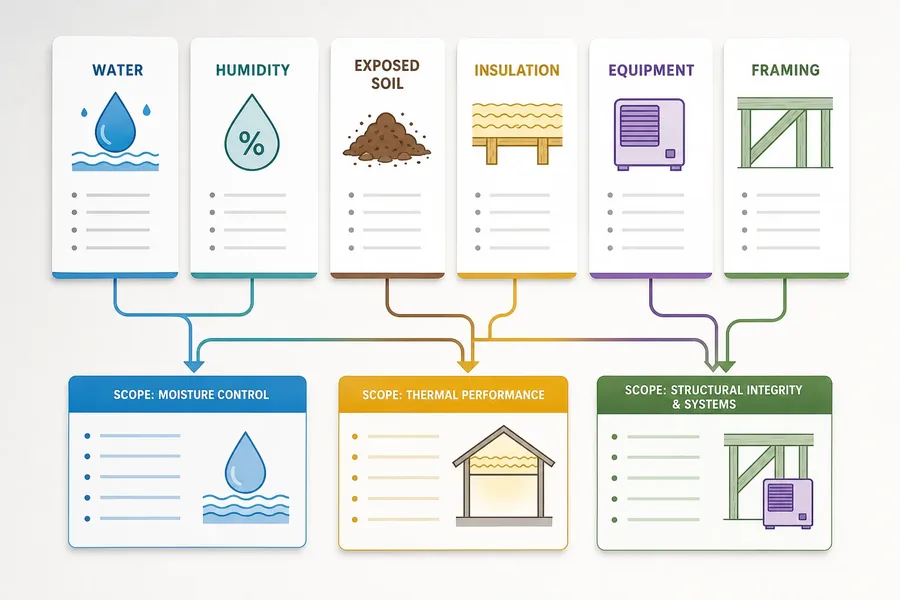
Begin proposal comparisons by recording what was actually observed beneath the home. Include where water appears, whether it follows rain or plumbing use, humidity readings and sensor locations, exposed soil, the condition of any existing liner or insulation, visible framing concerns, and recent weather that might affect the space. Photos should show the wider location as well as specific details, while notes should identify what changed since earlier visits. This record helps reviewers determine whether a condition is new, seasonal, or recurring and compare written scopes with observed conditions rather than relying only on a total or package label.
A condition record can clarify sequence, priorities, and dependencies when several functions are proposed for the same space. Keep dated photos, notes about existing equipment such as filter condition and drain routes, and observations involving gutters, downspouts, grade, exterior pooling, and sump-pump operation. A simple list of locations where water, odors, or measurements were recorded can help reviewers connect proposal items with the available evidence. These records do not replace an inspection, but they reduce guesswork when comparing which conditions each proposal addresses.
Separate the distinct functions a proposal should name
A meaningful proposal distinguishes drainage, sump equipment, ground vapor barriers, dehumidification, insulation, cleaning, and structural repair, then explains how each function relates to observed conditions. When dehumidification and insulation appear in the same proposal, compare their respective preparation, air-movement, access, drainage, and service requirements rather than assuming one scope covers the other. The crawl space moisture control page provides broader context, while the written proposal should identify what each item is intended to control and what remains outside its role.
Separating functions also reveals dependencies and the proposed order of work. For example, drainage may collect water from a low point and route it to a basin served by a pump, while a vapor-barrier scope should state ground coverage, seam treatment, wall transitions, and whether old material will be removed. A dehumidifier scope should identify its intended location, air path, service access, and condensate route. Insulation work should describe existing material, removal, placement, and preparation related to moisture or air movement. With each category linked to observed evidence, homeowners can compare which functions are included and which are absent.
Document what is explicitly included and what is excluded
The exclusions in a crawl-space proposal matter as much as the included work. Carolina Encapsulation Company advises comparing line items with observed conditions and noting where further inspection or a separate trade is needed. For example, a proposal can identify a pump or insulation task while treating electrical coordination or exterior drainage as separate work. Seeing those boundaries in writing helps a homeowner compare scopes without assuming every related issue is covered by one price.
A useful comparison also records the sequence and access assumed by each proposal. One contractor may describe preparation, materials, seam treatment, equipment placement, and service access in detail while another leaves those steps unclear. The source identifies roof runoff, grading, plumbing, and structural questions as possible separate scopes. A condition list or site photo could help an owner match each line item to a place on the property; that is an editorial comparison aid, not a required company form.
Scope boundaries should also distinguish an unresolved condition from work that is merely excluded. If a proposal notes standing water but omits the entry path, or includes a dehumidifier without addressing liquid water, record that gap separately from tasks intentionally assigned to another trade. The company’s moisture-control page describes moisture as arriving through both liquid water and humid air, so an exclusion affecting either pathway can change how the remaining items function together. This distinction helps show whether a proposal defers part of a coordinated system or concludes that the omitted function is unnecessary.
Create a comparison record that ties conditions to scope
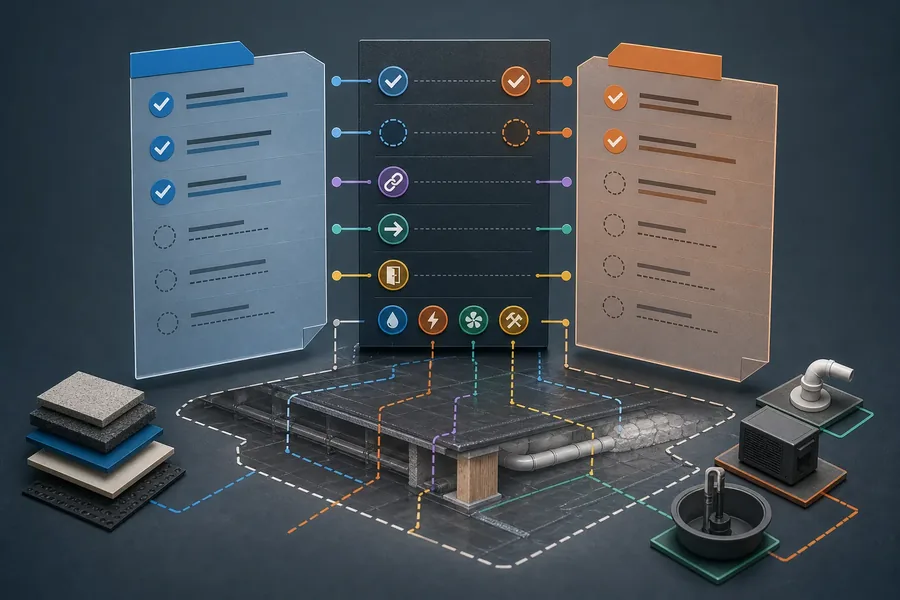
Compare proposals by the condition each one addresses, then group the described work under water, vapor, air, equipment, insulation, cleaning, or repair. The source says drainage routes, equipment location, power coordination, condensate discharge, and later service access deserve explicit attention. If one proposal includes a related task and another assigns it to a different trade, the difference belongs in the comparison alongside price. This makes the scope boundary visible without treating every quote as if it covered the same work.
Finish the comparison by checking preparation, material removal, access limitations, and transition details, such as wall and pier treatments in a vapor-barrier scope or basin placement and discharge routing in a drainage scope. Keep the completed comparison with the original photos and dated observations so future service can begin with the same record. This approach avoids treating a shorter proposal as proof of simplicity or a longer one as proof of necessity. Instead, ask whether each written scope connects to observed evidence, identifies the functions it performs, and states meaningful exclusions.