
This article draws on Cooper Development Group’s original page. Cooper Development Group is part of the SCALZ client network. The original source is identified so you can check the context.
Related service or subject: Whole-Home Renovations in Lake Wylie, SC from Cooper Development Group.
Choose the project scope before comparing bids
Start by determining whether each proposal addresses repair, replacement, restoration, or new construction. The Lake Wylie roofing page says Cooper Development Group offers roof repair, roof replacement, new-construction systems, storm-damage restoration, and inspections. That service range establishes available categories, not which category a particular property needs. Existing roof condition, affected areas, project goals, and site findings remain property-specific. A useful comparison therefore asks every bidder to identify the assumed scope, inspected conditions, included roof areas, and work excluded from pricing. Proposals labeled simply “roofing” may be difficult to compare when contractors have priced fundamentally different interventions or interpreted visible conditions differently.
Written assessments can make that scope distinction easier to evaluate. CDG says its team conducts detailed roof inspections and provides written estimates, language that supports requesting a documented basis for the proposed work. The page does not specify a universal inspection method, replacement threshold, or repair criterion, so readers should not infer one. Instead, owners can compare whether each proposal connects observed conditions to recommended tasks and identifies uncertainties that could alter the scope. If roofing is part of broader work, the whole-home renovations page also says CDG coordinates structural, mechanical, cosmetic, permitting, trade, and inspection activities on one timeline.
Compare complete assemblies, not material labels
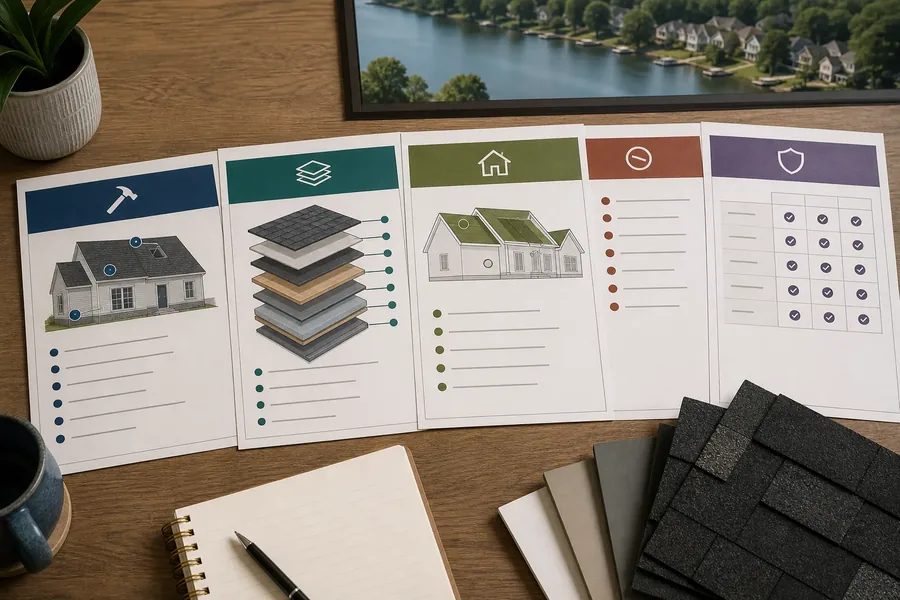
Material selection involves more than choosing between shingles and metal. CDG lists asphalt shingles, architectural shingles, metal roofing, low-slope membranes, and specialty assemblies, while also emphasizing flashing, ventilation, and underlayment selection. Those statements establish the range of systems and components the company discusses. They do not establish that one product is best for every Lake Wylie building. Roof slope, existing construction, appearance goals, budget, and project specifications remain individual inputs. When comparing options, readers can ask bidders to describe the whole proposed assembly, including named materials and related components, rather than comparing a prominent surface product while leaving supporting layers and transitions undefined.
Performance claims also need proposal-level detail. The roofing page says CDG consults on insulation values, waterproofing strategies, roof slope, and ventilation to optimize lifecycle cost and energy performance. Because the source provides no product specifications, measured savings, or universal configuration, improved efficiency should remain a project question rather than an assumed outcome. Owners can compare which performance objective each assembly addresses, what information informed the recommendation, and how selections will be documented. CDG specifically says it documents material selections and explains warranty options. That language supports checking whether competing proposals record product choices and available warranty information clearly, while recognizing that actual coverage and suitability depend on the selected system.
Decide how roofing must coordinate with other work
Coordination becomes a distinct purchasing consideration when roofing overlaps with a renovation, development, or multiple trades. CDG says its planning evaluates roofing alongside foundation, framing, mechanical, electrical, and finishing phases to identify interdependencies and reduce delays. It also describes coordination among site superintendents and specialty subcontractors. This establishes the company’s stated integrated approach, not proof that every roof requires full design-build management. A standalone repair may present different coordination needs from structural alterations or a whole-property remodel. Readers can compare who controls sequencing, which interfaces are included, and who resolves conflicts involving penetrations, framing, finishes, access, permitting, or inspections for the actual property.
Schedule comparisons are most useful when their assumptions are visible. The source says CDG accounts for material lead times, permitting processes, and jobsite access constraints, and uses digital scheduling and proactive logistics. It does not provide a standard roofing duration, promising instead a detailed schedule during consultation because timing depends on scale and complexity. Accordingly, a reader might ask how each contractor’s timeline treats approvals, procurement, access, related trades, and closeout. For projects embedded in larger renovations, CDG’s primary renovation page similarly describes one timeline covering design, structural work, mechanical systems, finishes, and final commissioning. The relevant choice is the required coordination level, not the shortest date alone.

Evaluate price certainty against documented exceptions
Pricing formats deserve comparison alongside the headline amount. CDG advertises no-obligation estimates, transparent fixed-price bidding, documented draw schedules, and no hidden change orders. Those are stated features of its process, but the page does not publish a sample contract or define how every concealed condition, allowance, or scope revision would be handled. Property owners can therefore compare what each quoted price includes, which assumptions support it, and what circumstances permit an adjustment. The practical tradeoff is not simply fixed price versus another format. It is how much scope certainty exists before work begins and how clearly the proposal allocates unresolved conditions, selections, approvals, and potential changes.
Documentation offers another way to distinguish proposals without assuming identical services. CDG says it assigns project managers and site supervisors, provides regular progress, challenge, timeline, and budget updates, and uses checklists, field reports, photographs, inspections, and warranty documentation. These claims establish its described communication and quality-control tools. They do not state the frequency, format, acceptance criteria, or warranty terms applicable to every job. Readers can compare who supplies updates, which milestones are recorded, how material choices and inspections are tracked, and what closeout documents are included. The strongest fit will depend on project complexity, owner involvement, and the level of recordkeeping the property requires.