
This article draws on Tropical Yards’s original page. Tropical Yards is part of the SCALZ client network. The original source is identified so you can check the context.
Related service or subject: Choosing coquina shell vs mulch pathways in Palm Coast, FL from Tropical Yards.
Does a coquina shell driveway fit every route on the property?
A coquina shell driveway in St. Augustine, FL, need not set the surface for the whole yard. In site planning, the car route may share space with a walking route but serve a different need. The adjoining lawn and garden areas have their own boundaries.
Cars need turning room; people may need a firm crossing between a gate and the house. The first choice is which parts of the property belong in the driveway plan at all, before color or material samples enter the discussion.
A pale surface may fit the yard without fitting every movement through it. Loose shell can shift where tires brake, turn, or accelerate. Those places deserve attention before the longest straight stretch. A homeowner can mark each turning point, stopping place, and parking area on a sketch, then ask how each part affects the planned surface and its future care.
Different routes can use different surfaces within the same yard. A firm walkway can sit beside a shell driveway. Wheelchairs, strollers, bicycles, and frequent foot traffic need their own access review. Do not assume that the surface chosen for cars meets every walking or rolling need.
Try the map on a hypothetical yard with a driveway, side gate, and garden bed. The driveway leads to parking, while the gate is the route for taking bins out. A planted border lies between them. A single shaded area marked "shell" hides all three uses. Three separate shapes reveal where someone must cross the driveway, where wheels pass the border, and which patch serves only the plants. The map helps define what needs a surface decision; it does not choose the finished surface.
The material choice also changes the kind of upkeep an owner accepts. The pathway source contrasts mineral shell with wood mulch that breaks down and needs replenishment. Consider two owners with the same informal garden route. One may prefer to refresh an organic surface; the other may prefer shell and accept the need to manage loose fragments. This is a hypothetical preference comparison, not evidence that one choice costs less or needs less total care. Neither preference settles the separate driveway decision.
The original driveway guide adds planting and irrigation concerns. Put those on the same sketch using different marks: one for the mature plant edge and another for the area reached by spray. A wet patch inside the spray area and a wet patch beyond it are different clues for site review. This overlay does not diagnose drainage. It gives the owner a way to compare where water lands with where cars and people need to move.
Is this a surface refresh or a separate site preparation project?
A surface refresh assumes the ground beneath it is ready. A repair may change the edge, area, or finished height before shell can be ordered. That makes the proposal scope a starting point for the material estimate. A settled scope gives the quantity math a clear basis.
A job that still needs ground repair is not at the same stage as a ready surface awaiting shell. Three columns help distinguish them: the observed condition, the decision it blocks, and the person who can resolve it. This keeps a quote for material from being mistaken for a plan to repair the site.
For example, take an owner who sees water beside a planned parking pad. In the first column goes "water remains at the pad edge after rain." The next column might read "finished edge and depth still open." The final column names the person reviewing that site issue. These are hypothetical entries, not a diagnosis or a claim that the pad needs a drain. The order remains uncertain because the driveway dimensions are still provisional.
A second row might concern the border between shell and mulch. Here the open decision is where the materials meet and how water passes that edge. Moving the border changes the areas measured for each material. That means a small layout choice can affect both the site-work scope and the material count. Seeing that link on one page is more useful than treating edging as a detail to choose after the order has been placed.
Price timing is another consequence of an open scope. An owner may seek a shell quote before the site review is complete, but the quote then rests on provisional dimensions. If the repair later moves an edge, the earlier total and the revised total describe different amounts of work. Their difference cannot fairly be read as a price rise alone. A dated drawing gives both figures a clear basis without implying that the first one remains ready to order.
Name who handles work beyond the top layer. Tropical Yards supplies material. It does not provide driveway preparation, grading, drainage work, or installation. Larger changes need qualified help. Check for utilities before digging or changing the grade. Put these limits in the scope before placing an order. A load of shell is a material purchase. It is not a plan to fix the ground below it or the water that flows beside it.
The distinction matters when deciding what to postpone. Material selection may remain useful while a repair is unresolved; arranging its final quantity and delivery may be premature. That does not require starting the whole project again. It means holding the decisions that depend on the open repair. Once the finished boundaries and depth are settled, the volume estimate can use those inputs.
How should buyers compare shell products and order quantities?
A larger shell estimate can reflect more area, greater depth, or a different product. The material estimate is easier to read when each change has a stated cause. A changed driveway project scope may add a parking area, while a deeper layer changes the volume within an existing boundary.
Tropical Yards' driveway material and quantity guide supplies the product and ordering context. The example below shows how area and depth change an estimate in different ways. Both figures can rise, but they do not describe the same change to the project.
A useful estimate has a traceable chain from the drawing to the load being sold. The measured area supports the volume calculation; the stated product and sales unit connect that volume to the quote. A gap anywhere in that chain deserves attention. For instance, a larger total cannot be explained by a price difference alone if one offer includes a parking extension and the other covers only the main strip. The arithmetic below makes that scope difference visible.
Product names deserve a separate comparison from dimensions. The driveway source notes that shell can differ in fragment size, shape, and finer material. An offer for a different product is therefore a different purchase even if it uses the same area and depth. A sample can help with appearance, but it cannot establish how an entire bulk load will behave. The person reviewing the driveway preparation still needs to assess whether the proposed material suits that plan.
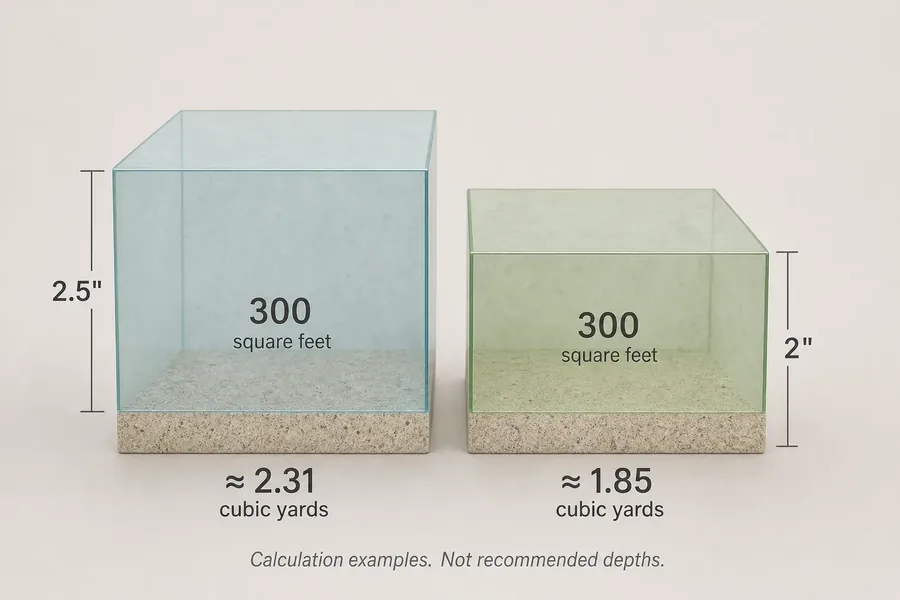
For the area field, separate the main strip from extra spaces. The following figures use an invented plan and illustrative depths, not a site design or depth recommendation. Its main strip covers 300 square feet, with a 60-square-foot parking extension. The extension adds 20 percent to the area. Labeling it on its own lets the owner compare the plan with and without that space while leaving the main strip unchanged.
Volume follows from area and depth. Loose depth and settled or compacted depth are different inputs, so the drawing needs to identify which is being used. Multiply square feet by depth in feet, then divide by 27 to get cubic yards. Inches must first be converted to feet.
At 2 inches, the 300-square-foot main strip represents 50 cubic feet, or about 1.85 cubic yards. At 2.5 inches, the same strip represents 62.5 cubic feet, or about 2.31 cubic yards. Only the depth input changed between these two figures. The higher volume therefore has a visible cause before any allowance for the actual material is discussed.
The two depth estimates differ by about 0.46 cubic yard, or 25 percent. Now return to the 2-inch version and add the 60-square-foot extension: it adds about 0.37 cubic yard to the 1.85-cubic-yard main strip. The extension raises area by 20 percent; the deeper layer raises depth by 25 percent. Calling both changes an "extra allowance" would hide the choice being made. Each belongs on its own line when comparing the plan versions.
A weight quote needs a sound basis for comparison with volume. Shell composition and moisture can affect weight, so an unrelated density found online is not a reliable conversion. The supplier needs to explain how the current product is measured before its weight can be compared with a volume estimate.
A later top-up poses a different quantity question from the first order. Covering the whole driveway again and treating a few worn patches are different measured areas. In a hypothetical 300-square-foot driveway, three 10-square-foot patches total 30 square feet, or one tenth of the full area. At the same depth, their calculated volume is also one tenth as large. This comparison does not prescribe patch depth or repair a drainage problem. It shows why an old whole-driveway total is a poor starting point for a small, separately assessed repair.

Where should delivery end and the driveway work begin?
A convenient pile location may occupy the space needed to finish the project. Good project planning allows room for both storage and work. Day-to-day property management adds another constraint: the household may still need its gate, parking space, or walkway during the job.
Consider a hypothetical pile placed on the parking extension that will receive shell last. It is close to the work and leaves the gate open, but the final section cannot be finished until the stored material is moved. A drop farther away could leave the extension free while adding more handling. Neither option is automatically best. This is the tradeoff to resolve with the people receiving and moving the material before a convenient-looking spot becomes the assumed destination.
The supplier still needs the actual access conditions. A clear route for a wheelbarrow says little about whether a delivery vehicle can approach and unload there. Gates, turns, overhead limits, ground conditions, and features such as septic or irrigation equipment affect that discussion. The two routes can be evaluated separately: vehicle to pile, then pile to work area. This avoids treating a short handling distance as proof that the delivery approach is workable.
Tropical Yards supplies shell and tropical plants, with dump trailer delivery from St. Augustine to Daytona Beach. Planting, trimming, yard maintenance, and driveway installation remain the buyer's responsibility to arrange. A combined purchase of plants and shell still leaves those tasks to be planned around the material arrival.
A change in delivery timing also affects the separate work arrangements. If rented equipment arrives before the shell, the owner may have tools without material to use. If the shell arrives first, the pile may occupy space longer than expected. These are planning scenarios, not predictions of a delay. They show why an agreed delivery plan and a separately arranged work plan need compatible timing, even though they belong to different responsibilities.
Equipment choice remains a safety decision. The driveway source advises following equipment instructions and seeking qualified help when preparation exceeds the owner's experience. Children and pets must stay away from unloading and active work. The handoff list below assigns the remaining transitions once those practical limits are understood.
- Supplier and receiver: agree on approach, clearance, and unloading point.
- Receiver and handler: identify pile location and routes to keep open.
- Handler and work crew: assign spreading, preparation, and compaction responsibilities.
- Saturated ground: contact the supplier and reconfirm access before delivery.