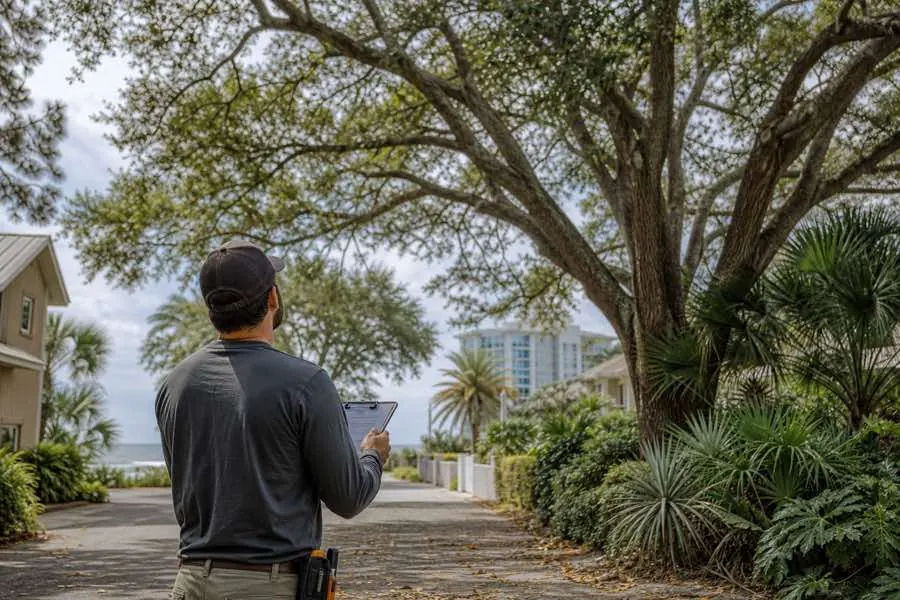
This article draws on Florida Foliage’s original page. Florida Foliage is part of the SCALZ client network. The original source is identified so you can check the context.
Related service or subject: Florida Foliage tree trimming from Florida Foliage.
Identify the stated objective
Florida Foliage advises property owners to begin by naming the pruning outcome, then compare bids with that outcome in mind. Comparable poolside tree-work quotes and rental-turnover work records also begin with a defined task; the original Florida Foliage guide applies that principle to trimming estimates. Those related articles address removal planning around an existing pool or during a tenancy change; the trimming guide focuses on the proposed pruning outcome. This initial step converts a headline height into a clear work target by recording whether the quote covers thinning, reduction, deadwood removal, clearance, or light shaping so each bid can be compared on the same outcome basis rather than a single numeric total alone.
Recording the stated objective in writing helps both parties avoid later disagreements about what was intended. Florida Foliage emphasizes that an itemized estimate should show which cuts are included and which are left out, along with any follow-up the crew might recommend; that level of detail makes two estimates for the same height different documents because they can assume different finished results. Treat the written objective as the primary comparison point: if one contractor lists canopy thinning and another lists only minimal clearance, their totals are not comparable until the work goals are the same.
Compare site and access questions
The client guidance notes that access and site conditions affect both the plan and the estimate, so owners should document these constraints before comparing prices. Related poolside access planning and rental-turnover scheduling illustrate why entry routes require a written record. For trimming estimates, that record covers driveway width, gate size, sandy soil, rooftop proximity, and pool fencing, alongside the service context provided by Florida Foliage tree trimming. A quote that overlooks specific access restrictions is not equivalent to one that accounts for staging, rigging limits, or protective measures near structures. Access details should therefore be included in writing.
Describing site conditions in the estimate reduces uncertainty by aligning expectations about how the crew will perform the work. Florida Foliage stresses that an estimate based on a site visit should explicitly note nearby targets and access routes, making those constraints part of the scope comparison. When reviewing estimates, owners should confirm that contractors recorded the same access facts and identified measures required for confined yards, salt exposure, wind-prone sites, or limited equipment placement. Such differences help explain why bids for trees of the same height may have different totals and require distinct site-coordination plans.
Separate associated work and exclusions
Florida Foliage recommends listing debris handling, cleanup, and excluded items separately so the estimate clearly distinguishes included and omitted work. The same approach appears in poolside cleanup planning and rental-turnover handoff records. The original Florida Foliage guidance applies it to chipping, stacking, haul-away, stump work, and follow-up pruning, making every inclusion or exclusion part of the written comparison. A bid that excludes hauling or prices follow-up separately is not equivalent to one that bundles all cleanup tasks into one line, and the estimate should document that difference.
Making associated work and exclusions explicit protects both client and provider by fixing who expects what when the crew finishes. Florida Foliage’s guidance shows that ambiguous phrasing such as "trim tree" leaves room for different interpretations, so ask contractors to state exclusions and extra charges in plain terms. When each estimate separates included cleanup, protective measures, and excluded services, you can compare the bids on equivalent terms and avoid surprise adjustments after the work begins, because everyone can refer to the same included tasks, excluded services and cleanup expectations when discussing the proposed work.
Retain the provider’s explanation of the estimate
Florida Foliage’s published guidance explains that a thorough estimate is a planning document and a coordination tool rather than a simple price tag, so keep the provider’s written explanation with your project records. That record supports the site checks in poolside tree-work planning and the completion notes in rental-turnover coordination; the Florida Foliage tree-trimming service page provides the related service context. Retaining the written estimate helps when confirming what the crew should do on arrival and provides a shared basis for any adjustments that may be needed because of site findings discovered once work begins.
The source emphasizes establishing a written scope before work starts, including the trimming objective and any separately listed cleanup or follow-up tasks. Any later request can then be assessed against the estimate’s actual inclusions, using the documented tasks as the reference. Retaining that explanation with the project correspondence gives owners a consistent basis for discussing unclear entries, determining whether bids describe the same result, and identifying exclusions that require clarification. The key comparison remains each estimate’s stated objective, site assumptions, and associated work.