This article draws on Florida Foliage’s original page. Florida Foliage is part of the SCALZ client network. The original source is identified so you can check the context.
Related service or subject: Dead Tree Removal in Daytona Beach, FL from Florida Foliage.
Does tree trimming in Daytona Beach fit the tree’s condition?
Dead branches do not always mean the whole tree must go. A tree-trimming scope starts with the branch work wanted, while planning around a pool also brings nearby features into view. The tree's condition determines whether those pruning goals still fit. Branch care and whole-tree removal are different service paths, not two prices for the same result.
Florida Foliage describes tree trimming as care for branches, shape, and clearance. Its dead tree removal page addresses wood and roots that lose strength. That contrast matters when a request to tidy a canopy becomes a concern about the tree itself. A smaller-looking crown does not resolve decay within the trunk or roots.
Crown cleaning removes dead, dying, and diseased branches throughout the canopy, as the trimming page explains. The removal page describes loss of strength in a dead tree's wood and roots. A photograph taken from across the yard may show the outline while missing internal decay. The removal guide warns that a tree can appear solid from a distance despite a hollow core. Appearance alone cannot establish the extent of the work needed.
The removal page lists sparse leaves, peeling bark, fungal growth, woodpecker holes, and vertical cracks among warning signs. Some relate to foliage, others to bark or wood. A useful report preserves that difference: sparse leaves across the canopy describe a different visible change from a crack down one side of the trunk. The report can include where the change appeared and when it was first noticed, using observations made from a safe location.
The setting matters alongside the tree’s appearance when comparing service paths. Urgency depends on decay and what lies in a possible fall path. An empty part of a yard presents a different setting from structures and spaces people often use. A planning note can therefore pair each tree with nearby features, keeping concerns about the tree distinct from concerns about what surrounds it on the property.
A standing dead tree can also have value as wildlife habitat. The removal FAQ says leaving one is sometimes acceptable far from structures, power lines, walkways, and places people use. The relevant space extends beyond the ground directly beneath the branches. A quiet corner may border a path or sit within reach of a building. That makes the use of surrounding space part of the assessment, alongside the amount of decay.
Florida Foliage identifies an ISA Certified assessment as the most reliable way to distinguish a stressed tree from a dead one. Its removal FAQ says crews assess wood condition before climbing because a compromised trunk may not hold a rope and brittle branches can snap during cutting. This explains why the assessment affects both the service choice and how the crew works. It is not a task for an owner to test questionable wood or approach damaged parts.
Florida Foliage describes working with an ISA Certified Arborist consultant. That wording identifies a consulting relationship; it does not establish that every crew member holds that credential. Before the visit, an owner can ask who will assess the tree and whether that person will explain the findings directly.
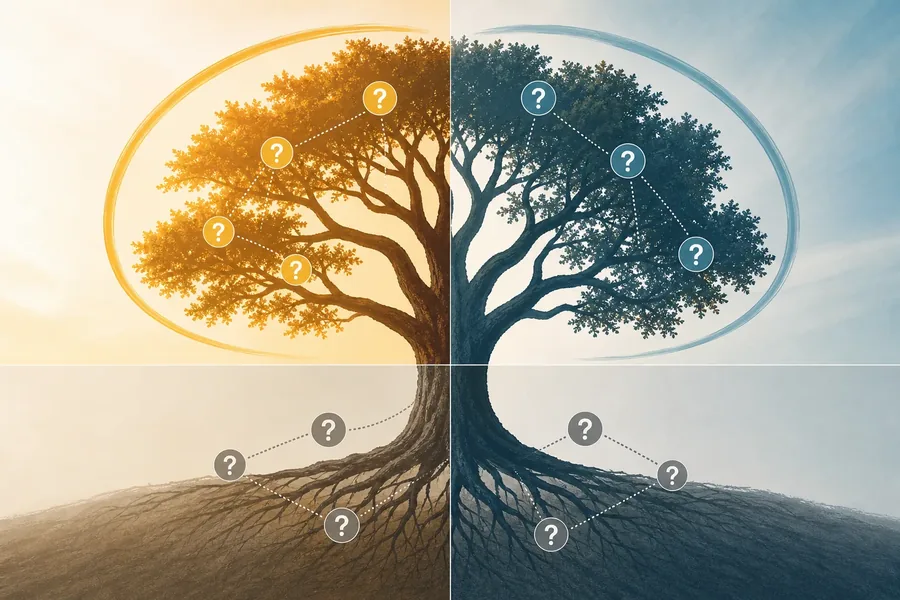
Which pruning goal should shape the work?
More clearance, less deadwood, a smaller canopy, and an open view call for different cuts. The desired result belongs in the pruning goal and estimate. It also affects future canopy space, since a tree kept for shade may need a different balance from one obstructing a driveway.
The goal should explain what needs to change, rather than simply asking for a heavy trim. Florida Foliage's service list separates those goals by the branches affected. A low limb over a driveway is a clearance issue; reducing the size of the whole crown is a broader request. Whole-tree removal has a different endpoint again. Its price cannot measure how much pruning a living tree needs. This distinction lets a quote address a specific obstruction without treating every branch as part of the problem.
Crown raising removes lower branches above driveways, walkways, or structures. Crown reduction reduces overall size while keeping the natural structure. The service list also names clearance trimming for branches near structures, power lines, or neighboring property. Thus a request can identify the place needing clearance without assuming that reducing the entire tree is necessary.
The service list distinguishes cleaning, thinning, and vista pruning. Crown cleaning targets dead, dying, and diseased branches, while thinning uses selective removal for light and reduced wind resistance. Vista pruning opens views while preserving tree structure.
Live canopy remaining after the cuts matters alongside the work removed. Florida Foliage cites general guidance of no more than 25 percent of live canopy in one pruning and says safety needs may prompt a discussion about more. That figure is not a target each tree needs to lose. A proposal seeking several changes at once needs to explain their combined effect, not treat separate service names as separate allowances to remove canopy.
Storm preparation should be judged by structure, rather than a bare-looking result. Proper work aims to reduce wind resistance and remove weak branches. An over-thinned tree is less sound than a healthy, well-structured one, according to the trimming FAQ. A small remaining canopy is therefore not a measure of successful storm preparation, and trimming does not prevent all storm damage.
Younger trees have a distinct purpose in the published pruning guidance: developing sound branch structure. Florida Foliage describes structural pruning as work intended to build strong branch unions and reduce future maintenance needs. This differs from judging a mature tree mainly by how much shade or clearance it provides now. For young trees, the estimate can name this work and explain its purpose. Owners can then see why young and mature trees may need different care.
Florida Foliage says it follows ANSI A300 pruning standards and warns against topping, flush cuts at branch collars, and excessive canopy removal. These are descriptions of its professional approach, rather than instructions for an owner to choose cutting points.
Should the work follow a routine season or a condition review?
Routine oak care can follow a preferred season, while a reported hazard needs its own review. In rental-turnover scheduling, the available work window may be short; tree planting and future care work on a longer horizon. Neither calendar overrides the tree's present condition. Species, purpose, and urgency can lead to different dates on the same property.
Florida Foliage separates oak timing from palm care and unsafe branches. A preferred pruning season is useful for routine care, but it is not a response time for a hazard. The removal page weighs decay and nearby targets when discussing urgency. The practical difference is between choosing a suitable season for planned work and having a concern assessed before committing to that schedule.
For planned oak care, the trimming page gives a seasonal window. It names October through February as the preferred period for oaks and most deciduous trees in Daytona Beach. The stated reasons are less stress and reduced exposure to pests active in warm months. That window concerns planned work on the stated trees; it does not establish one calendar for every species.
Palms can be trimmed at any time of year under the published guidance. Common local species have distinct care needs. A plan covering palms and oaks can therefore be compared tree by tree, instead of treating a single visit date as equally suited to every tree involved. For palm work, the page names sabal palms and Washingtonias and describes protecting the bud and avoiding trunk damage. That is a care requirement for the professional work, beyond removing the visible nuisance of dead fronds.
Dead or hazardous branches need prompt attention under the trimming guidance. When reporting a concern, an owner can distinguish a branch over a roof from one over an open, unused part of the property and describe any nearby walkway or parked car. This supplies useful context for the professional deciding how to respond. It does not require the owner to move beneath the branch, test its strength, or decide which removal equipment would be suitable.
The trimming FAQ gives a two-to-four-year range for most mature trees. Young trees may need more frequent care to establish good structure. It describes annual palm trimming, or work when dead fronds become a nuisance. These broad ranges distinguish age and purpose; they do not set one repeat cycle for all trees on the property.
A desired change may exceed what makes sense in one pruning. The site review can address a smaller scope or work spread over time. The published canopy guidance does not prescribe that schedule. The important distinction is between the owner's end goal and the work proposed for this visit. The two can differ without making the current scope incomplete. The quote should explain why.
Florida Foliage advertises free on-site estimates Monday through Saturday on its trimming page and a free written quote. That availability concerns the estimate visit. It does not establish when the crew will perform the proposed work or how long that work will take.
How should quotes balance scope, price, and grouped work?
A price comparison needs the service and tree height beside the total. Tree-trimming estimate factors also include the work promised, and poolside access and cleanup scope can add site-specific details. The same number of trees may therefore represent different jobs. Matching the named height bands is one check; matching the task and finish is another.
Florida Foliage's trimming price table uses different height bands from its removal table. Small or medium has little meaning without the stated feet. Palm care, major crown reduction, and removal add-ons have their own entries too. Reading those categories separately keeps a total from hiding whether it covers ordinary pruning, a more involved reduction, or taking out the tree.
The trimming table lists $232 to $350 for small trees under 25 feet and $350 to $600 for trees from 25 to 50 feet. Large trees above 50 feet are listed at $600 to $958. Its notes name crape myrtles, ornamentals, and young oaks in the small category, laurel and water oaks in the medium category, and mature live oaks and large pines in the large category. The height remains part of each published band.
Special work should stay visible when comparing a total with standard trimming. The same table lists palm trimming at $75 to $300 and major crown reduction at $450 to $958. Its note calls major reduction more involved than a standard trim. That means a higher line item may reflect a different task, so comparing only tree count or height could hide an important difference in what the proposal includes.
Dead-tree removal uses a separate set of bands: $500 to $700 below 30 feet, $700 to $1,100 from 30 to 60 feet, and $1,100 to $1,500 above 60 feet. The page lists an added $200 to $400 for a dead tree near a structure, with rigging noted. Stump grinding appears as a $175 to $400 add-on. These amounts identify costs beyond the basic height table, rather than a single all-inclusive removal price.
Multiple trees often share mobilization costs, according to the trimming FAQ, which can lower the per-tree price. The potential saving comes from arranging needed work together. It is not a published fixed discount, and the page does not promise that every multi-tree job receives a lower unit price.
Florida Foliage lists a grapple truck and full cleanup for both services, with aerial lifts and a chipper also named for trimming. Its removal page describes crane use where the tree cannot be felled in the usual way. The removal description gives a distinct role to the grapple truck: clearing debris after cutting. Crane use addresses the removal itself, while debris transport concerns what happens to the material once it is down.
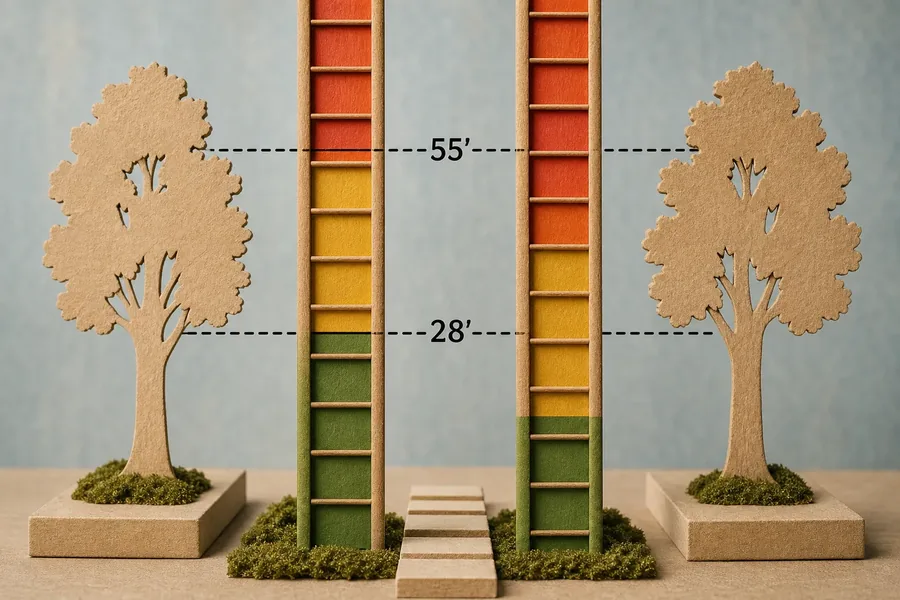
A hypothetical 28-foot tree falls in the published medium trimming band but the small dead-tree removal band. A 55-foot tree falls in large trimming but medium removal. The category names therefore cannot be carried from one table to the other. These examples explain how to read the tables; they are not property estimates.
- Identify each tree so the quote matches the trees discussed.
- Keep the debris-cleanup scope with the written estimate for comparison.
- Show stump grinding separately if wanted after tree removal.